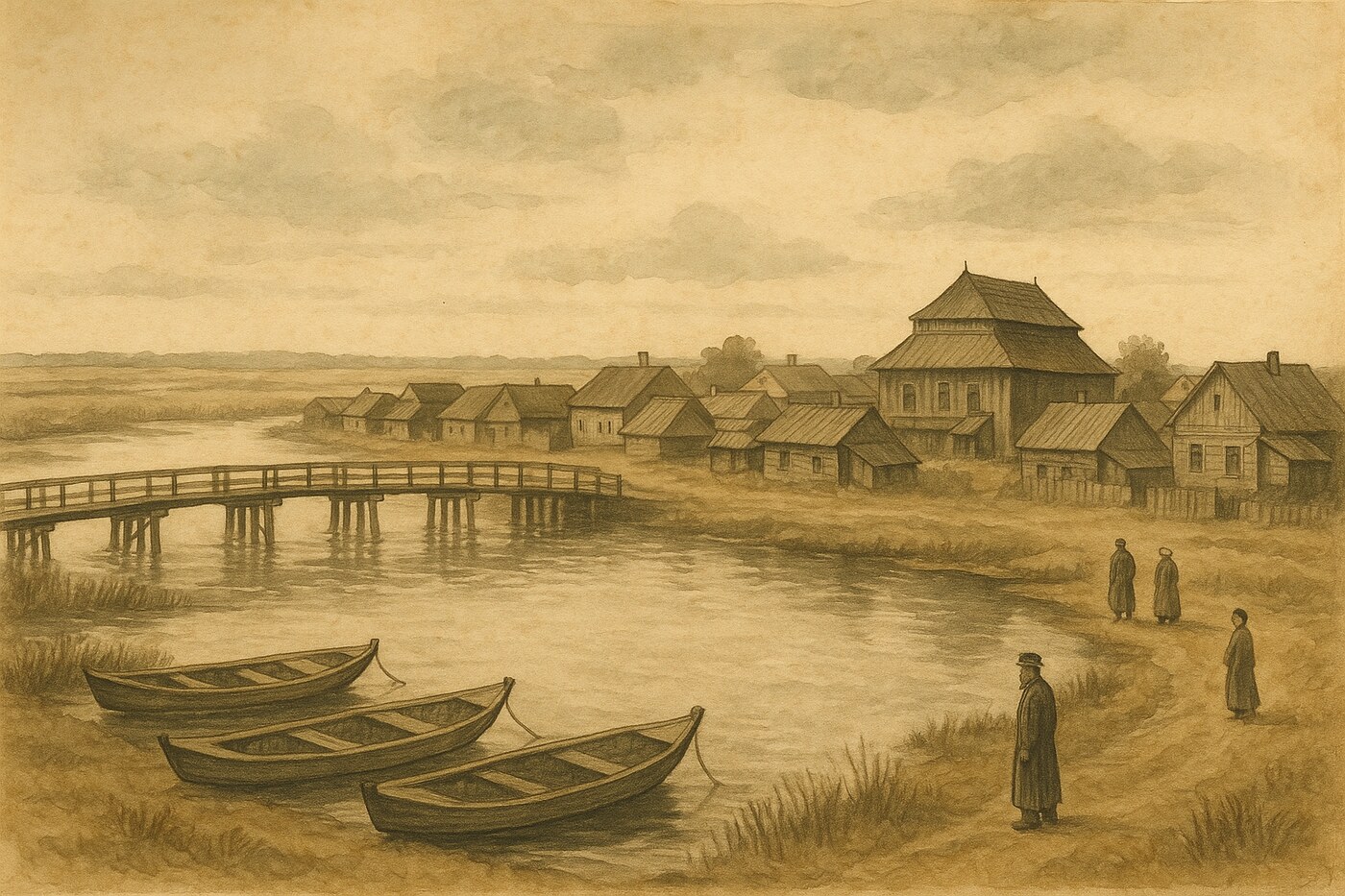
David-Horodok
Jewish life, families, institutions, destruction, survival, and remembrance in the river town of David-Horodok on the Horyn.
- Evidence nodes
- 5,488
- Node types
- 15
- Book scans
- 508
- Region
- Polesia (Brest Region)
Everything here is read from the real pages
You are browsing Sefer zikaron David-Horodok — the David-Horodok Yizkor memorial book, written by survivors in Hebrew and Yiddish. Every person, family, place, and event on this site was read from its actual scanned pages, and each fact links back to the exact passage and scan it came from. Nothing is invented; the original page is always one click away — a modern way to browse a primary source, not a replacement for it.
About David-Horodok
Articles on the events, people, places and institutions that shaped the community — drawn from its memorial book and the wider historical record — and guided paths through the book itself.
- Article · 1868–1938
David-Horodok’s fires brought the town together to build a brigade
Repeated fires were serious enough to prompt residents to establish a firefighters’ association, making communal self-organization part of town life.
Read - Article · 1905–1921
David-Horodok’s revolution, pogrom threats, and the Balakhovtsy violence
Revolutionary politics and repeated threats of violence tested the community while spurring political activity and efforts to protect residents.
Read - Article · 1917
David-Horodok’s 1917 opening: a community elects, learns, and celebrates
The political opening after the February Revolution enabled new democratic community institutions and a visible flowering of Hebrew education and civic activity.
Read - Article · 1921–1940
David-Horodok’s interwar institutions and the emigration of its people
Banks, schools, libraries, political movements, and elections reveal a community building its institutions even as migration carried residents away.
Read - Article · 1939–1941
David-Horodok welcomes the Red Army, then lives under repression and occupation
The change from Polish rule to Soviet power and then German occupation overturned civic life and ushered in arrests and persecution.
Read - Article · 1941–1944
David-Horodok’s Jewish community destroyed by massacre and expulsion
The mass murder of the town’s Jews, the killing of those still hiding, and the discovery of an empty town at liberation mark the destruction of the community.
Read - Guided path · 4 chapters
What kind of Jewish community was David-Horodok?
This path introduces the institutions and everyday structures that made David-Horodok a functioning Jewish community. By the end, readers will see a town shaped by religious practice, education, economic cooperation, and mutual aid.
Follow the path - Guided path · 4 chapters
How did politics and changing borders shape the town?
This path follows socialist, Zionist, and communal political activity alongside the successive authorities that governed David-Horodok. It helps readers understand why political ideas, migration plans, and state power mattered so deeply to local lives.
Follow the path - Guided path · 4 chapters
How did occupation become persecution and mass murder?
This path moves from military occupation and forced labor to roundups, ghettos, and killings. It shows how the memorial book records destruction through both collective events and individual victims.
Follow the path - Guided path · 4 chapters
How did people resist, hide, and survive?
This path follows the different possibilities recorded in the book: escape from ghettos, help from non-Jewish people, partisan warfare, and dangerous attempts to cross borders. It emphasizes survival as a series of individual acts under extreme constraint, not a single experience.
Follow the path - Guided path · 4 chapters
What happened to families after the destruction?
This path brings the story from wartime loss into liberation, return, rebuilding, and justice. It helps readers understand that survival involved fractured families, physical return to a devastated town, and the creation of new lives elsewhere.
Follow the path - Guided path · 4 chapters
How does the memorial book remember David-Horodok?
This path explores how testimony preserves names, family links, religious memory, survival accounts, and the pursuit of perpetrators. Readers will learn to approach the memorial book as a source of remembrance whose accounts must be read with attention to who is speaking and what is being preserved.
Follow the path - Chronology · 15 moments
David-Horodok through time
Every dated event and testimony in the book, in order, each connected to its source.
Open the chronology
People, families, places, and events
Enter the historical record through a familiar subject. Each result remains connected to the passage that supports it.
You know things this book doesn't
A memorial book holds what its compilers could gather, decades ago and often from memory. Families carry the rest — a photograph, a maiden name, a street, a correction to a date. Editors of David-Horodok can add that context to any node, with their contribution recorded and reviewable.
Reading needs no account. Editing is invite-only, so the record stays accountable.
No one is keeping David-Horodok yet. If this is your family's town, you could be the first — the book is already open, it just needs someone who knows what it left out.