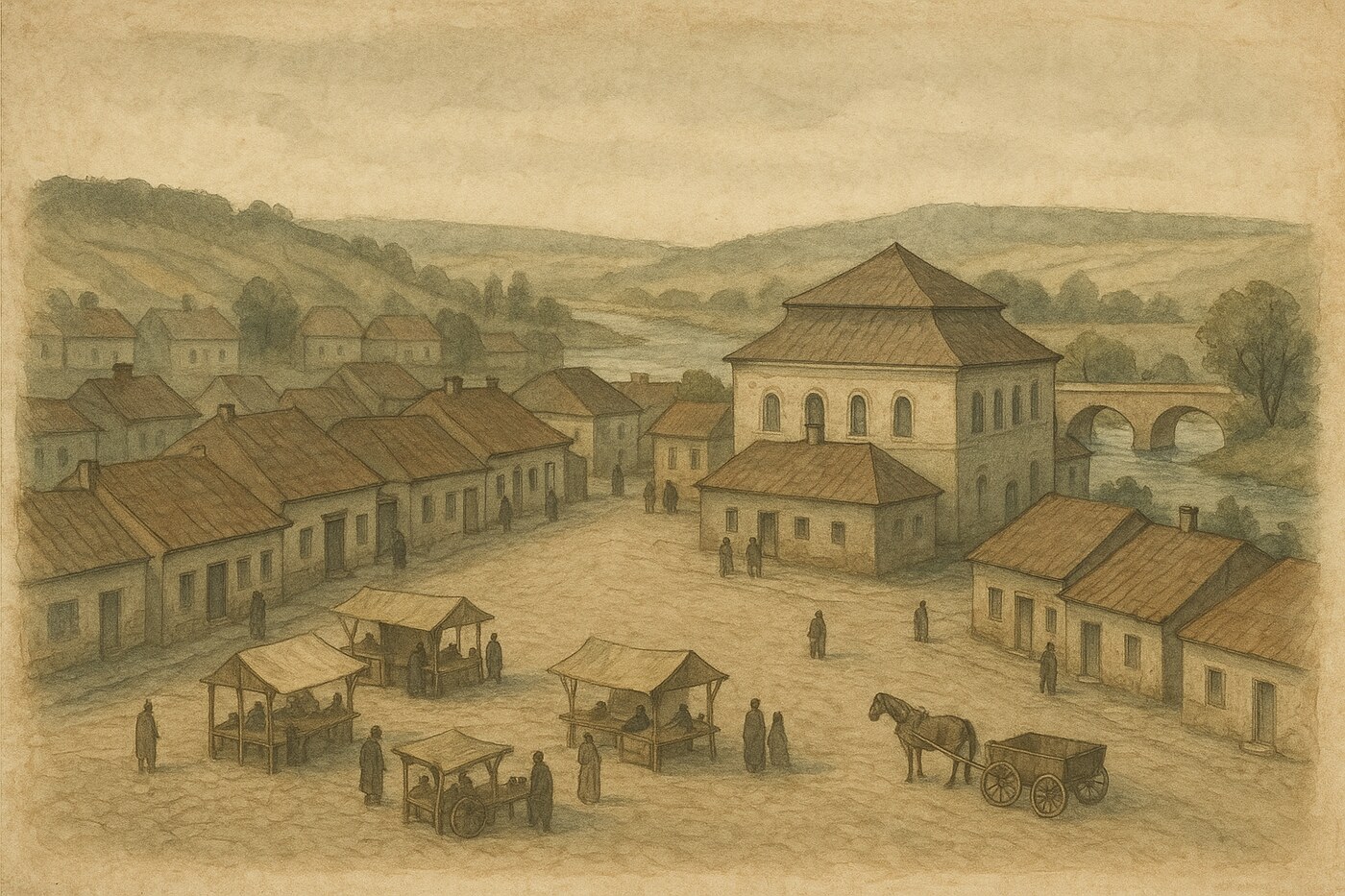
Skala-Podilska
Jewish life, families, institutions, destruction, survival, and remembrance in the community of Skala-Podilska.
Keeping this memory alive
These supporters help keep the Skala-Podilska memorial book read, researched and open to everyone, so the community it remembers is not forgotten.
 Alon Carmel
Everything here is read from the real pages
You are browsing Skala (New York, 1978) — the Skala-Podilska Yizkor memorial book, written by survivors in Hebrew and Yiddish. Every person, family, place, and event on this site was read from its actual scanned pages, and each fact links back to the exact passage and scan it came from. Nothing is invented; the original page is always one click away — a modern way to browse a primary source, not a replacement for it.
- Evidence nodes
- 2,261
- Node types
- 14
- Book scans
- 395
- Region
- Podolia (Ternopil Oblast)
About Skala-Podilska
Articles on the events, people, places and institutions that shaped the community — drawn from its memorial book and the wider historical record — and guided paths through the book itself.
- Community · 1560–1945
Skala’s Jewish Community: A Town and Its People
The memorial book’s many accounts make the community itself the essential starting point for understanding the lives and history it preserves.
Read - Theme · 1939
Markets, Fairs, and the Trade That Sustained Skala
Trade and commerce connected Skala to nearby villages and distant markets, revealing how the town made its living.
Read - Institution · 1906–1939
Hebrew Education and the Schools of Skala
Schools and teachers shaped the learning and cultural life of generations of Skala’s Jewish children.
Read - Theme · 1830–1942
Hasidic Life and the Kloizn of Skala
Skala’s distinct Hasidic groups and prayer houses show the variety of religious traditions within the community.
Read - Theme · 1906–1939
Zionist Organizing, Youth, and Mutual Aid in Skala
Zionist initiatives in Skala joined youth organizing and Hebrew culture with practical efforts to support neighbors.
Read - Event · 1939–1944
Persecution and the Destruction of Skala’s Jews
The wartime accounts document how occupation, forced labor, deportations, and mass murder devastated Skala and its Jewish residents.
Read - Event · 1943–1944
Forest Shelters and Bunker Survival in Skala
Accounts of bunker builders, hidden families, and survivors illuminate both the danger and resourcefulness of people seeking refuge near Skala.
Read - Guided path · 4 chapters
What kind of Jewish community was Skala?
Explore how geography, religion, work, family life, education, and culture made Skala a living community rather than merely a wartime location. By the end, you will see the institutions and relationships that gave Skala its distinctive character.
Follow the path - Guided path · 4 chapters
How did political change affect Skala?
Follow Skala through the First World War, Polish and Soviet rule, Zionist organizing, and the arrival of German occupation. You will understand how state power repeatedly altered ordinary community life before the destruction began.
Follow the path - Guided path · 4 chapters
How was Skala’s Jewish population destroyed?
Trace the escalating system of forced labor, deportation, ghettos, camps, shootings, and Aktionen described in the memorial book. The path shows how destruction unfolded over time and affected both the community as a whole and named individuals.
Follow the path - Guided path · 4 chapters
How did people survive, resist, and help one another?
Read survivor accounts of flight, hiding, underground bunkers, escape routes, mutual aid, and armed resistance. By the end, you will see survival as a series of dangerous choices made by individuals and groups, not as a single outcome.
Follow the path - Guided path · 4 chapters
What survived after Skala was destroyed?
Follow survivors after liberation as they returned, emigrated, pursued justice, supported one another, and built memorial practices. You will understand how the community continued through people, institutions, testimony, and organized remembrance.
Follow the path - Chronology · 11 moments
Skala-Podilska through time
Every dated event and testimony in the book, in order, each connected to its source.
Open the chronology
People, families, places, and events
Enter the historical record through a familiar subject. Each result remains connected to the passage that supports it.
You know things this book doesn't
A memorial book holds what its compilers could gather, decades ago and often from memory. Families carry the rest — a photograph, a maiden name, a street, a correction to a date. Editors of Skala-Podilska can add that context to any node, with their contribution recorded and reviewable.
Reading needs no account. Editing is invite-only, so the record stays accountable.
- Alon CarmelSince April 2026